
Syllabus Resources and Policies
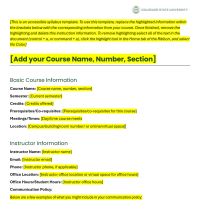
DOWNLOAD THE ACCESSIBLE SYLLABUS TEMPLATE
The syllabus template has been designed by stakeholders at CSU and provides a recommended structure and the necessary content that a syllabus should include. Make sure your syllabus has electronic accessibility.
Go to the Assistive Technology Resources Center (ATRC) for more information and tutorials.
Please see below for policies relevant to your courses and campus resources to help you with various challenges you may encounter
Please add to your syllabus this QR code and/or short link (https://col.st/2FA2g) with a statement informing students that the linked page provides policies relevant to their courses and resources to help with various challenges they may encounter.
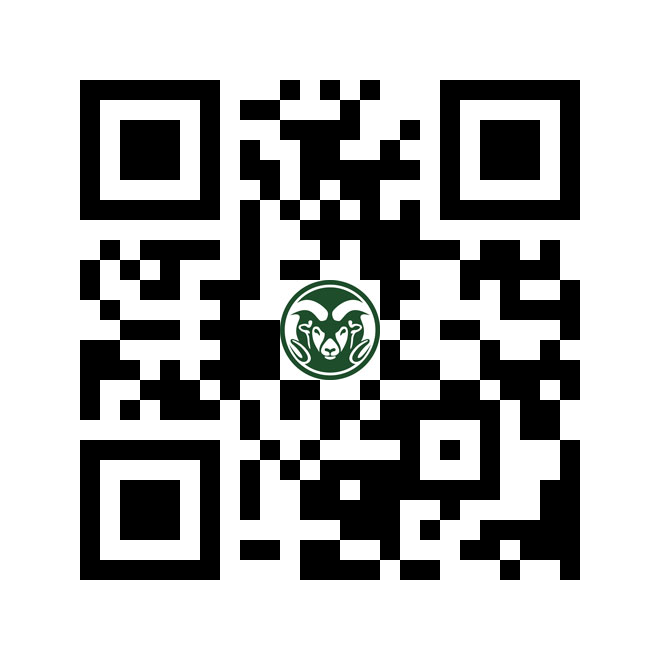
Please see below for policies relevant to your courses and resources to help with various challenges you may encounter.
Please add to your syllabus this QRN code and/or short link (https://col.st/2FA2g) with a statement informing students that the linked page provides policies relevant to their courses and resources to help with various challenges they may encounter.
Contents
Canvas Information and Technical Support
Canvas is the learning management system (LMS) where course content, grades, and communication will reside for this course.
Login: canvas.colostate.edu
Support: canvas.colostate.edu/support
For passwords or any other computer-related technical support, contact the Central IT Technical Support Help Desk.
Voice: (970) 491-7276
Email: [email protected]
For info on using browsers, apps, and third-party tools with Canvas, see Student Support Canvas.
Further information about Academic Integrity is available at CSU’s Academic Integrity – Student Resources.
Universal Design for Learning/Accommodation of Needs
CSU is committed to the principle of universal learning. This means that our classroom, our virtual spaces, our practices, and our interactions should be as inclusive as possible. Mutual respect, civility, and the ability to listen and observe others carefully are crucial to universal learning.
If you are a student who will need accommodations in this class, please contact your instructor to discuss your individual needs. Any accommodation must be discussed in a timely manner. A verifying memo from The Student Disability Center (SDC) may be required before any accommodation is provided.
The Student Disability Center (SDC) has the authority to verify and confirm the eligibility of students with disabilities for the majority of accommodations. While some accommodations may be provided by other departments, a student is not automatically eligible for those accommodations unless their disability can be verified and the need for the accommodation confirmed, either through SDC or through acceptable means defined by the particular department. Faculty and staff may consult with the SDC staff whenever there is doubt as to the appropriateness of an accommodative request by a student with a disability.
The goal of SDC is to normalize disability as part of the culture of diversity at Colorado State University. The characteristic of having a disability simply provides the basis of the support that is available to students. The goal is to ensure students with disabilities have the opportunity to be as successful as they have the capability to be.
Support and services are offered to student with functional limitations due to visual, hearing, learning, or mobility disabilities as well as to students who have specific physical or mental health conditions due to epilepsy, diabetes, asthma, AIDS, psychiatric diagnoses, etc. Students who are temporarily disabled are also eligible for support and assistance.
Any student who is enrolled at CSU, and who self-identifies with SDC as having a disability, is eligible for support from SDC. Specific accommodations are determined individually for each student and must be supported by appropriate documentation and/or evaluation of needs consistent with a particular type of disability. SDC reserves the right to ask for any appropriate documentation of disability in order to determine a student’s eligibility for accommodations as well as in support for specific accommodative requests. The accommodative process begins once a student meets with an accommodation’s specialist in the SDC.
Copyrighted Course Materials
Consult the instructor’s syllabus for the rights and responsibilities related to creative works.
Immigrant Student Support
Any CSU student who faces challenges or hardships due to their legal status in the United States and believes that it may impact their academic performance in this course is encouraged to visit Student Support Services for DACA & ASSET for resources and support. Additionally, only if you feel comfortable, please notify your professor so they may pass along any additional resources they may possess.
Food Insecurity
Any CSU student (along with faculty and staff) who is experiencing food insecurity can receive support from the Rams Against Hunger program. Services include a food pantry, a meal-swipe program, pocket pantries, and in-person assistance with navigating federal aid eligibility. The RAH page includes numerous resources as well as county, state and federal programs which are described and linked.
Title IX/Interpersonal Violence
For the full statement regarding role and responsibilities about reporting harassment, sexual harassment, sexual misconduct, domestic violence, dating violence, stalking, and the retaliation policy please go to: Title IX – Sexual Assault, Sexual Violence, Sexual Harassment.
If you feel that your rights have been compromised at CSU, several resources are available to assist:
- Student Resolution Center, 200 Lory Student Center, 491-7165
- Office of Equal Opportunity, 101 Student Services, 491-5836
A note about interpersonal violence: If you or someone you know has experienced sexual assault, relationship violence and/or stalking, know that you are not alone. As instructors, we are required by law to notify university officials about disclosures related to interpersonal violence. Confidential victim advocates are available 24 hours a day, 365 days a year to provide support related to the emotional, physical, physiological and legal aftermath of interpersonal violence. Contact the Victim Assistance Team at: 970-492-4242.
Religious Observances
CSU does not discriminate on the basis of religion. Reasonable accommodation should be made to allow individuals to observe their established religious holidays.
Please see CSU’s Religious Observances Calendar.
Students seeking an exemption from attending class or completing assigned course work for a religious holiday will need to fill out the Religious Accommodation Request Form and turn it in to the Division of Student Affairs, located on the second level of the Administration building.
Once turned in, the Division of Student Affairs will review the request and contact the student accordingly. If approved, the student will receive a memo from the Dean of Students to give to their professor or course instructor.
Students are asked to turn in the request forms as soon as the conflict is noticed. Similarly, unanticipated conflicts requiring a religious observance, such as a death in the family, can also be reviewed.
CSU Principles of Community
Inclusion: We create and nurture inclusive environments and welcome, value and affirm all members of our community, including their various identities, skills, ideas, talents and contributions.
Integrity: We are accountable for our actions and will act ethically and honestly in all our interactions.
Respect: We honor the inherent dignity of all people within an environment where we are committed to freedom of expression, critical discourse, and the advancement of knowledge.
Service: We are responsible, individually and collectively, to give of our time, talents, and resources to promote the well-being of each other and the development of our local, regional, and global communities.
Social Justice: We have the right to be treated and the responsibility to treat others with fairness, the duty to challenge prejudice, and to uphold the laws, policies and procedures that promote justice in all respects.
Student Parents/Guardians/Caregivers
CSU recognizes that student parents/guardians and caregivers face distinctive challenges in succeeding academically, and we are committed to supporting those of you who are parents to achieve course learning outcomes. If you encounter challenges in meeting course expectations – for example, fulfilling attendance and participation requirements or submitting assignments due to a child or person in your care’s illness, essential appointment, school closure, etc. – please contact your instructor as soon as possible (beforehand if feasible or as soon afterward you reasonably can if not). Work with your instructor to develop a plan for you to make up missed work. Also, please see the course syllabus for related course policies. If you need to bring your child or person you care for to class, for example because you’re nursing or planned childcare became unavailable, check with your instructor about whether you may do so if you believe it’s feasible for you to participate in class and support your child or person in your care.
Group work assignments should be designed to provide flexible approaches to participating, and all groups should develop plans that enable all members to contribute equitably. If your group encounters challenges in doing so, please reach out to your instructor to devise a solution.
Finally, know that pregnant and parenting students are guaranteed equal educational opportunities by Title IX; know your rights, the protections provided, and how to advocate for yourself.
Student Case Management
The Student Case Management & Referral Coordination office provides crisis prevention and intervention services. In difficult or crisis situations, students may find it challenging to navigate the academic consequences, university processes, and campus and community
resources available. Student Case Management consult with students, faculty, staff, families, and providers to offer guidance on the next best steps. We help find the best approach to support students in the immediate situation and provide referrals for ongoing support. https://studentcasemanagement.colostate.edu/.
Additional suggested language for the syllabi:
When students have difficult or life impacting issues that affect their academic work, it is recommended that you speak directly with your professor about your course work. Open and regular communication with your professor is the recommended first course of action.
Mental Health and Wellness
CSU Health Network is here for you. Whether you need support with your physical or mental health, CSU Health Network has an integrated team of trained professionals who are committed to caring for mind and body. Visit health.colostate.edu or call (970) 491-7121 to find out what support is right for you. In addition, your student fees provide access to a wide range of mental health and well-being support resources.
If you are concerned about a friend or peer, visit tellsomeone.colostate.edu or call (970) 491-1350. Tell Someone is a CSU service that allows you to report concerns about a student or employee who may be struggling with issues related to health, wellbeing, or threats of violence. Reach out and ask for help if you or someone you know is having a difficult time.