Unlocking Note-Taking Success: 4 Strategies for College Students
As any seasoned student knows, college isn’t just about showing up to class and praying for an A; it’s about harnessing the power of good note taking.
The difficult part about note taking is that there isn’t exactly one perfect note taking strategy – depending on your subject, topic, lecturer, and learning style. From decoding chalkboard hieroglyphics to capturing the main portions of a detail-ridden lecture, the way you take notes can make or break your study game.
We’re going to present 4 go-to, proven note taking strategies, talk about when it may be useful to use them, discuss pros and cons for each, and then give you some tips to use regardless of your strategy at the end.
Why Does Good Note Taking Matter?
Solid note taking is crucial for college success by improving comprehension and retention of course material. Effective notes help you organize and review key concepts, facilitating better study habits and exam preparation. By capturing essential information and main ideas during lectures, you can create self-made resources for revising and understanding complex topics.
Additionally, good note taking encourages active listening and engagement, fostering a deeper connection with the subject matter and improving overall academic performance.
The Outline Method: The Classic Approach
What Is It?
The Outline Method is the meat and potatoes of note taking techniques. You probably met this method in middle school, and it’s stuck around for a reason: It’s chronological and hierarchical, making it easy and quick to use on the fly, and just as easy to review later.
How To Do It?
Main points aligned to the left as headlines, supporting subpoints go underneath, indented slightly to the right. Further details go underneath and even more indented. Whenever the subject changes, go back to the left and create a new subheading.
When To Use It?
It’s the go-to method for most classes where you need to jot down information, especially if it’s mostly written information. If you’re in a rush, or just need something that feels comfortable, this is the strategy to follow.
Pros:
Visually clean and organized
Converts easily into study notes
Cons:
Not ideal for subjects with lots of charts or other visuals
Struggles with lectures that jump around
Can lead to taking too many notes (aka, writing down every single word)
Outline example where main subjects are underlined and have detailed bullet points indented underneath for visibility when studying.
The Cornell Method: The Gourmet Option
What Is It?
If the Outline Method is your meat and potatoes meal, then the Cornell Note Taking Method is the dry-aged filet mignon with a twice baked potato. Created by Cornell University professor Walter Pauk (hopefully not a vegetarian) in the 1950’s, it is a more active note-taking technique that helps you digest information more effectively.
It encourages you to summarize key points, actively engage with the material, and develop a deeper understanding, making it a top choice for serious students everywhere.
How To Do It?
Put the subject title at the top. Summary area at the bottom should take up about 1/3 of the page and will be the last thing you’ll fill out. In the areas between the headline and the summary area, dedicate the right 70% to be for all your notes, and the left 30% to be for “cues” – The note taking area is where you will be jotting down details like steps, quotes, meanings, processes, etc. The Cues columns is for things like keywords, names, questions, dates, new vocabulary… you know, the “big” stuff.
When To Use It?
This method is much like the Outline method where it can be used for just about any class, but it’s especially useful for classes when you have lots of discussion or subjects like sciences, humanities, and especially math.
If your current note taking just isn’t cutting it for you, give this a try.
Headline at the top, summary at the bottom. The middle section should be 70% dedicated to the note taking area and 30% cue columns
Pros:
Encourages understanding and summarization.
Easy to skim for memorization.
Cons:
Takes time to set up the page
Requires effort to summarize after the lecture
BONUS FOR MATH:
This is a great option for math because it gives you space to work out problems, follow your steps, put a main idea or formula at the top, and jot down equations.
The Mind Mapping Method: Visual Learning At Its Finest
What Is It?
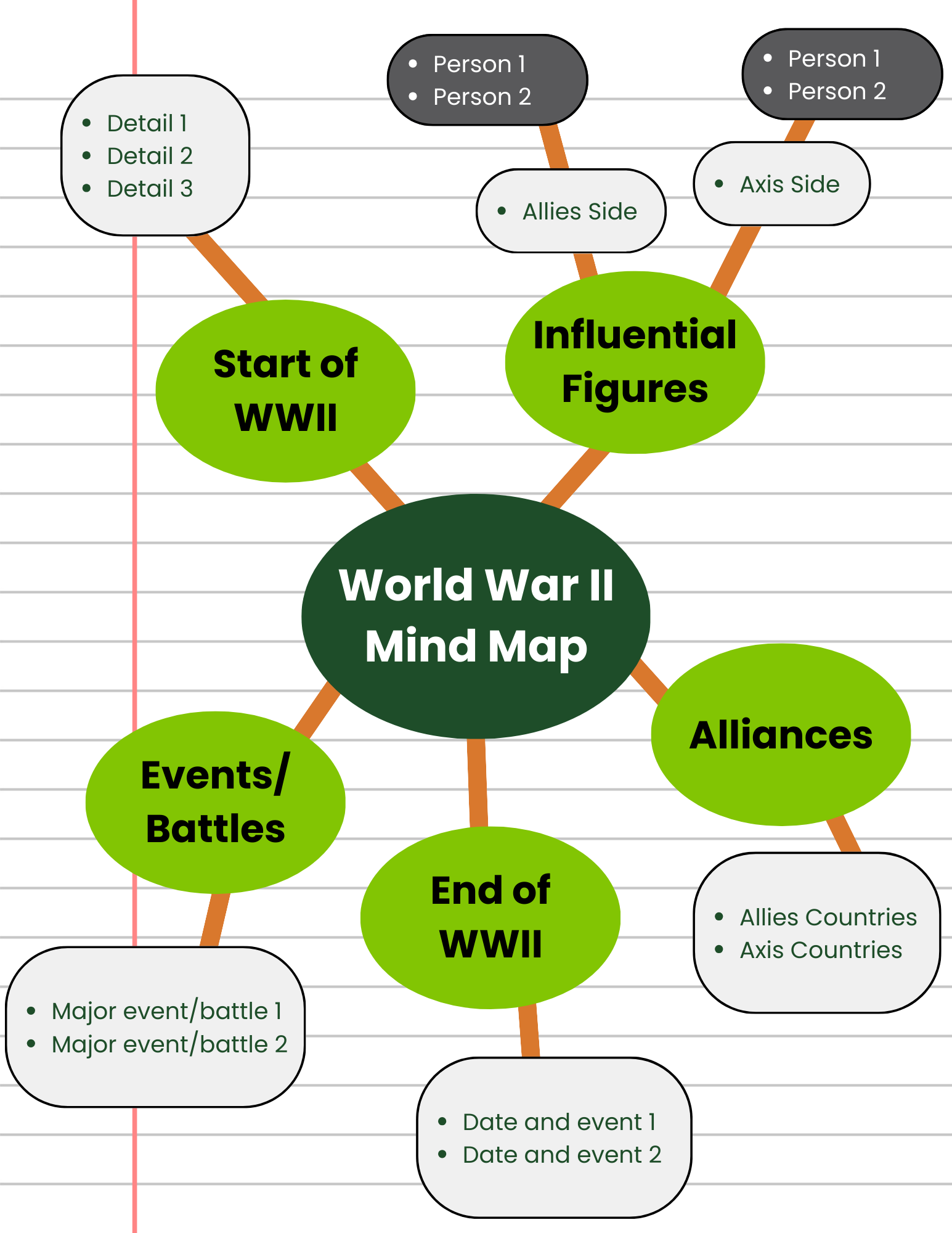
Mind mapping is for the Picasso in us all. It’s a visual method that starts with a central idea and branches out into related details, making it ideal for visual learners. It’s great for summarizing and memorizing information and allows for improved recall when test time comes around.
How To Do It?
Start with the central idea in the center, branch out into main subtopics, add details and related ideas branching off from those subtopics.
When To Use It?
It is ideal for courses in history, literature, biology, psychology, and business, where making connections between ideas is crucial.
It’s also a great resource for collecting information to write an essay or hoping to get chronological steps in a visual pattern with more details.
Pros:
Visual representation of complex topics
Breaks down large ideas into smaller concepts
Visual elements promotes memory recall
Cons:
Easy to run out of space quickly
Requires revising notes to stay clear on details and draw connections
Can be time-consuming to create while also trying to understand information during lectures
Main idea has it's focus in the middle, with a few major points outside of that and smaller details from there. Bonus points for color coordination.
The Charting Method: For Structured Lectures
What Is It?
Think of the charting method as a super-organized spreadsheet for your notes. It’s great for subjects with lots of data, comparisons, or chronological information. It’s an excellent method to condense lots of notes and see the details you’ll need to know.
How To Do It?
Divide your page into columns with appropriate headings (e.g., dates, pros/cons, people, etc.) and fill in the boxes as the lecture progresses.
If you know the subjects that will be covered ahead of time in lecture, you can set columns and rows up ahead of time. If not, you can use the charting method as a way to revisit your notes and make a great study tool.
When To Use It?
Perfect for lectures with a clear structure, fast content delivery, or when comparing and contrasting ideas. It’s also a great method for studying in a more visual form, allowing you to see connections between ideas. It’s great for subjects that have lots of facts, structured information, or information that can be compared and contrasted like history, business, economics, chemistry, and biology.
Pros:
Reduces writing
Easy to review and memorize facts
Cons:
Less useful when lectures are unstructured
Difficult to use during class discussions
Each column has its own category of information and each row has its own topic allowing you to easily compare details of each