
Office for Undergraduate Research and Artistry


TILT Support for
Community Engaged Learning at CSU
TILT’s Community Engaged Learning programs serve:
- Faculty and instructors who are developing and teaching CEL/ SL (Service Learning) courses
- Community partner organizations who host and co-create CEL and SL opportunities
- CSU students
TILT’s Community Engaged Learning program offers Community Engaged Learning (CEL) / Service Learning (SL) Mini-Grant Funding. These grants, typically ranging from $500 to $1,000, are available to fund the development of new CEL courses or initiatives, or the improvement of existing ones.
Review Application Instructions and Qualifications Below
An overview of the Community Engaged Learning Mini-Grant program including new updates, support for proposals, frequently asked questions, examples of proposals, and previous projects. Includes time for questions and discussion.
November 18th 12-12:45pm | MS Teams
For Faculty & Staff
Connect with TILT for a one-to-one consultation or other course development resources. Contact Danyel Addes, Program Coordinator for Community Engaged Learning.
Join our CSU mailing list to get notifications of CEL/SL opportunities and events for academic and campus-based partners.
Subscribe
Join our CSU email list
CEL Mini-Grant Fall 2026 Funding
Apply Before Sep. 8
The Institute for Learning and Teaching (TILT) is offering Community-Engaged Learning (CEL) Mini-Grants of $500–$1,000 for FALL 2026 courses that connect academic learning with meaningful community partnerships. These grants help CSU faculty and staff design courses that link academic learning with meaningful community partnerships—whether that means enhancing an existing project or starting something new.
CEL Mini-Grant Information Session
August 20th 1:00pm | MS Teams
Join us for an overview of the Community Engaged Learning Mini-Grant program including new updates, support for proposals, frequently asked questions, examples of proposals, and previous projects. Includes time for questions and discussion.
CEL Mini-Grant Info Session Recording
The recorded session requires a CSU email account. Enter your [email protected] email address on the echo360 sign in page and you will be redirected to the NetID login.
CEL Mini Grant FAQ's
Can I see examples of previous proposals?
Yes. We will continue to add examples of different kinds of proposals here
Examples of a robust academic project with established community partnership (running for a year or more)
Example of a proposal focused on one key element- stronger community partnerships- and documents, tools, and steps for communication and logistics and introducing students
What is the purpose of the Collaboration form?
The collaboration form was added to the CEL Mini Grant process to emphasize support for projects where there is already relationships/collaboration underway. The main goal is for those reviewing proposals to have some way to see that conversations have already happened between you and your community partners and that the idea for the project isn’t being created first and then a community partner has to be found to help complete it. (For additional information on why this is an important consideration see this resource list on experiences of community partners and those most impacted by community projects)
If my class has many community partners do they all need to sign a separate Collaboration form?
The hope with the Collaboration form is to meet the goal stated above while not creating barrier to the process for those involved. If you have a unique situation or many community partner organizations, please reach out to Danyel Addes to touch base on how to handle the Collaboration form. [email protected]
I’m not sure if my project meets the criteria for a mini-grant. What else can you say about eligibility?
CEL mini-grants can be used to support research/scholarship projects if they:
- Are undertaken with community partner organizations or use/teach a community-based participatory research methodology.
- And provide a learning opportunity for a group of CSU students.
If your project is a research/ scholarship endeavor please include a brief overview of relevant research questions, research methods, and the roll of community members or partners in the development of the research and/or your plan for how data and results will be shared (depending on the stage of the project).
What do you mean by curriculum in the context of this application?
This Mini-Grant program is designed to support and help develop community engagement efforts that are part of curricular programs. This includes academic curricula for credit and co-curricular programs where participants do not receive academic credit but the project is connected to a programmatic structure that includes a curriculum.
For these purposes, we consider a curriculum be something includes, at a minimum:
- Learning objectives,
- Information about how the learning objectives will be met and
- A plan for evaluating the learning and/or project outcomes
How detailed should the application be?
These are small grants and one way to use them is for small pieces of more complex projects. If you are focused on one specific element of a project – like a community partner survey, a pre-assessment assignment for students, or hosting an event to present information to community partners, it is ok to focus on the most relevant information, but please make sure to let us know the larger context. You are welcome to include supplemental documents like syllabi, draft assignments or research proposals. Please list them in the application where there is space to do so.
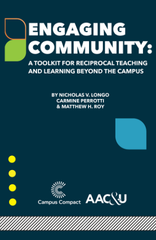
A New Toolkit to Strengthen Community-Engaged Teaching and Learning
A new free, open-access publication from American Association of Colleges & Universities (AAC&U) and Campus Compact offers practical resources to help faculty and campus leaders put those principles into practice.
For questions and additional information contact:

For Community Partners
Hear more about our approach to community partnerships, ways to connect with faculty and students, and support for co-teaching and project development. Contact Danyel Addes, Program Coordinator for Community Engaged Learning.
Join our Community Partner mailing list to get notifications of opportunities and events for community partners, including ways to connect with courses, professors, student leadership programs.
Subscribe
Join our community partner email list
For Students
- Are you looking for Community Engaged Learning, Service Learning, or research opportunities?
- Do you have a class or graduation requirement that includes an in-depth community engagement component and you are trying to find the right organization or group to work with?
- Are you curious how Community Engaged Learning is different from volunteering or community service?
- Are you doing Community Engaged Learning (receiving academic credit for community-based work) and could use some support, or guidance?
- Are you creating a research poster or presentation about a Community Engaged Learning project? Could you use some examples, guidance or feedback?
Community Engagement work needs many minds to be done well. The best way to get good at it is to talk it over with others. Meet with our Program Coordinator for Community Engaged Learning to discuss a project, ask questions, figure out next steps, or connect with opportunities.
Subscribe
Join our student email list
The Provost's Council for Engagement
The Provost’s Council for Engagement advances the practice and recognition of our integration of academic scholarship and community engagement. As a faculty-driven initiative, established in 2016, the Provost’s Council advances the scholarship of engagement, including engaged teaching, engaged research and engagement with communities across Colorado and the world.
In 2019, the Council introduced a “Continuum of Engaged Scholarship” framework to identify the breadth of engaged research, teaching and service activities moving from outreach to co-creation, while offering a model to individual faculty and departments for documenting progress, demonstrating impact and evaluating performance. The Continuum presents the What, Why, and How of Engagement, conducted across the university’s mission areas.

More Community Engaged Learning at CSU
Project & Course List
Help us build a list of Community Engaged / Service Learning projects and courses! This will make it possible for :
- People to see examples of Community Engaged Learning, Teaching, and Scholarship projects at CSU and look for projects of interest
- Instructors and community groups who are looking for Community Engaged Learning partnerships to find each other and connect directly
Let us know about your Community Engaged Learning or Service Learning work. You can indicate if you are actively looking for partners or collaborators and if or when you are open to inquiries. Please submit information about your project even if you are not currently looking for partners as it helps us build an inventory of these efforts across campus and Northern Colorado.
The Office of Engagement and Extension: Become an Agent of Change
Partner with Colorado State University.
CSU’s Office of Engagement and Extension delivers on its land-grant mission by making the university’s educational programs, services and resources accessible to all, enabling individuals to act as agents of change and together build thriving communities.
Award Winning CSU Programs
The Middle School Outreach Ensembles (MSOE)
The Middle School Outreach Ensembles (MSOE) program is an internationally recognized, community-based music outreach program sponsored by CSU that provides music instruction to local middle school students. The program embodies CSU’s land-grant mission, providing equal opportunity and equal access to its music programming through loaned instruments and expert music lessons at an extremely low cost.
Campus Connections Theraputic Youth Mentoring Program
Campus Connections Therapeutic Youth Mentoring program is a high-impact service learning course (3 credits) at Colorado State University and a program serving local youth. Campus Connections was developed in 2009 in response to a community request for additional services for youth experiencing difficulties. CC is an innovative core service for youth exposed to adversities providing mentoring in a unique structure. This includes mentor mentees pairs being part of a mentor family (four pairs) with youth of similar ages, exposure to a college campus, academic support, dinner, pro-social activities, and integrated mental health services. Youth are referred from the juvenile system, schools, human services, and many other providers who recognize the tremendous benefits of therapeutic mentoring for youth.