Office for Undergraduate Research and Artistry

OURA Lab at CSU Spur
2027 program dates TBD (10 weeks)
Learn lifelong skills this summer at the remarkable CSU Spur campus
Apply to the paid undergraduate research program today!
Application Deadline
March 13
CSU Fort Collins Student Application Deadline
–
March 30
CSU-Pueblo Student Application Deadline
Application Deadline
TBD
Stay tuned! Application deadlines will be announced before the spring semester begins.
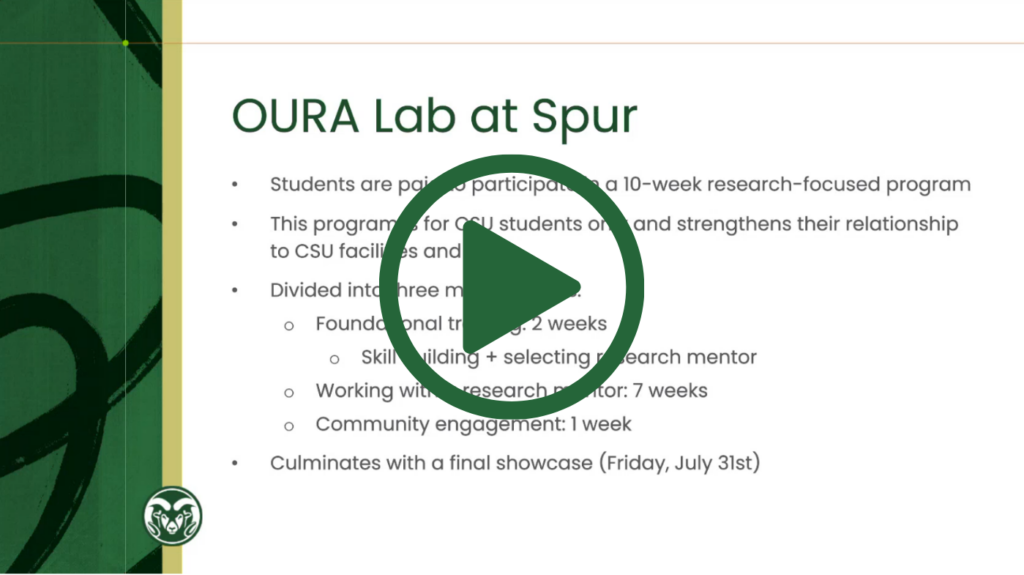
Information Session Recording
Application Deadline
March 1
CSU Fort Collins Student Application Deadline
–
March 30
CSU-Pueblo Student Application Deadline
Information Session
Februay 16
4-4:30pm | Microsoft Teams
Attend to get an overview of the OURA Lab at CSU Spur, learn more about the application process, and ask any questions you have!
What is the OURA Lab?
The TILT OURA Lab provides an opportunity for undergraduate students to learn laboratory and research skills that can be transferred to future research experiences. The OURA Lab is intended to be a comprehensive experience that allows students to engage in the many phases of research, from conducting background research to inform the project’s scope to the development and execution of experiments.
This program addresses two significant barriers to undergraduate research participation: lack of time and financial compensation.
OURA Lab provides a space to demystify research, give students confidence, and increase self-efficacy to do research past the OURA Lab. While fostering collaboration and community, the OURA Lab is a safe place to try new things, learn from mistakes, and test again without fear of a letter grade.

What is CSU Spur?
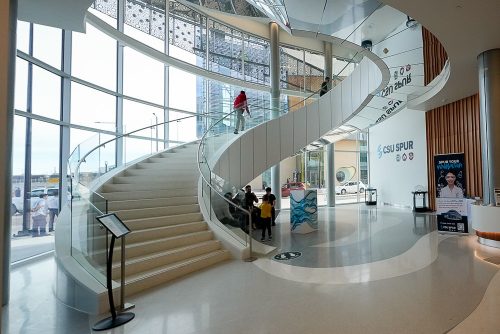
CSU Spur is a year-round destination for science, research, community service, and education for the greater public. Located roughly a mile from the intersection of I-25 and I-70 in Denver, The first of Spur’s three educational buildings – Vida, Terra, and Hydra – broke ground in May 2020 as a part of a transformation of the National Western Center, which is also host to the annual National Western Stock Show.
This collaborative campus brings together education, research, and engagement in essential areas like food, water, and health. CSU Spur aims to address global challenges through collaboration and innovation.
With programs like the OURA Lab, volunteer opportunities, community partners, and more, there is truly something at CSU Spur for everyone.
Why OURA Lab at CSU Spur?
Until now, TILT’s OURA Lab only offered paid student opportunities on CSU’s main campus in Fort Collins during the fall and spring semesters. Expanding the OURA lab to the CSU Spur campus increases both the number of students CSU can serve and the quality of research and learning opportunities available. CSU Spur has state-of-the-art research facilities built to engage in cutting-edge work. Because Spur has been intentionally designed to increase access to science and research for the general public, it is an ideal site for a program that introduces students to lab and research.
Understanding that not every student is able to participate in the OURA Lab during the school year due to other obligations, we are thrilled to provide this program for the first time in the summer of 2024 at CSU Spur.
CSU Spur and TILT’s OURA Lab strive for the same thing – provide educational resources to overcome barriers to science-related fields and have students observe and contribute to connecting research and community.

How Can I Apply?
Students interested should apply by midnight on Friday March 13, 2026 for priority review. All applications after this date will be accepted on a rolling basis. Interviews will be conducted the following week either virtually or in person.
How Can I Apply?
Applications for OURA Lab at Spur Summer 2025 will open soon – check back soon!
For Immediate questions, please reach out to OURA’s Associated Director, Courtney Ngai, at [email protected]
How Can I Apply?
Applications for OURA Lab at Spur Summer 2026 are officially open!
Students can access the Application via Handshake
For immediate questions about the application, selection process, or summer program, please contact OURA's Associate Director, Courtney Ngai, at [email protected]
Handshake Job Posting #10723035
Highlights from 2024 Cohort
Frequently Asked Questions
Do I need to live in Denver to be part of this program?
The program involves daily, in-person activities on campus and is committed to advancing Spur’s mission to support local communities. While living in Denver or nearby is not explicitly required, you will need to ensure you can reliably and realistically be at Spur each day for the duration of the program. Please see the linked recommendations for getting to Spur to plan your commute.
Is the OURA Lab at CSU Spur paid?
Yes, it is! Students will be paid $19.26 an hour. Students should expect to work 40 hours a week.
When does the program start? How long does it last?
The 2027 program dates will be announced in the spring. For reference, the 2026 program started on Tuesday, May 26 and ended on Friday, July 31st, lasting a total of 10 weeks.
*For reference, the Spring 2027 semester ends on May 7th and the Fall 2027 semester begins on August 23rd
Is this a class?
No, this is not a class. Since it is not a class, you will not earn college credit, pay a fee for participating, or need to register for this program with the registrar’s office.
This opportunity is more like a paid internship or a job where you are working and contributing to research, and is designed to help you in future courses, labs, and professional work.
What should I expect?
This 10-week program will have a “scaffolded” approach where students learn introductory lab and research skills, learn in different labs at CSU Spur to increase exposure to various types of research, and design a community engagement project at the end for a student showcase.
Students will be paid to learn 40 hours/week throughout the summer and will begin the first two weeks by being introduced to basic lab and research skills through the OURA lab.
The next seven weeks will involve students working in different CSU Spur labs to increase exposure to different types of research.
In the final week of the program, students will design an activity, exhibit, demonstration, or other form of interactive communication related to sharing research with the general public. The program coordinator will work with Spur staff to identify potential areas of research that students can make more accessible to the general public, and students will be invited to address the community engagement needs of Spur buildings for their project.
Is there lodging available?
Currently, there is not lodging available for students for this summer program, which is why we recommend students apply if they plan to live near or within driving distance of CSU Spur campus (4777 National Western Dr., Denver, CO 80216).
Do I need prior lab or research experience?
No you do not! The OURA Lab program is designed to provide any student with little to no lab or research experience with an opportunity to learn the necessary skills to go forward with lab work and research.
What major do I need to be in to participate in OURA lab?
Any major is welcome to apply
Where can I get more information?
A great way to learn more about this opportunity is by attending an Information Session. These will be scheduled for early in the spring semester.
For all your questions, contact the program coordinator, Courtney Ngai at [email protected] or submit a question using the form at the bottom of the page.
2026 Research Mentors

Dr. Jennifer Bousselot
Research Group: Green Roof and Urban Agriculture
Research Overview: Green roof agriculture topics like crop selection, shade tolerance, and environmental conditions
More About Dr. Bousselout's Research
Our research focuses on urban agriculture including green roofs, rooftop agriculture, and the combination of rooftop agriculture and solar panels known as rooftop agrivoltaics.
What Projects Can Students Engage In?
Our raspberry production rooftop agrivoltaics research (data collection, plot maintenance, etc.) or the rooftop sown meadow research (counting flowers, weeds, etc. in plots).
Skills Students Will Learn
The seasonality of applied research data collection. We move between outdoors and controlled environments for our research. We often use a shared laboratory space.
How Big is The Research Group, and Who Would Students Be Working With?
Our team consists of a principal investigator, a postdoctoral fellow, three PhD graduate students and four Masters graduate students spread across the front range from Fort Collins to Colorado Springs. We always hire 3-5 interns and summer hourly help. Over half of our team is in Denver at the Spur campus.
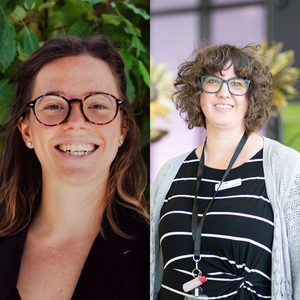
Dr. Martha Calvert & Dr. Caitlin Clark
Research Group: CSU Spur Food Innovation Center
Research Overview: Food product development and sensory science research
More About Calvert & Clark's Research
Food product development and sensory science research which is used in the food and beverage industry to create or improve food/beverage products and to evaluate if they are acceptable among consumers, or improve marketing of those products. This work supports local food businesses and entrepreneurs.
What Projects Can Students Engage In?
- Chocolate/Confectionery work (making chocolate, testing novel ingredients and/or processes),
- Food analysis (using instruments to measure properties of food products, such as pH, relevant to food safety and quality),
- Product development (determining what a client needs to design, and helping design it and create it with the team),
- Method development (finding the best cooking or preparation method to make a product or dish work best, like America’s Test Kitchen),
- Sensory testing (carrying out a sensory study to answer specific consumer or marketing questions about a food or beverage product)
Skills Students Will Learn
- Food chemistry,
- applied food science,
- experiment design,
- hypothesis testing,
- project management skills,
- designing a food or beverage product,
- client interaction, etc.
How Big is The Research Group, and Who Would Students Be Working With?
Our group includes two food scientists and 3-5 technicians who will also work alongside the student(s).
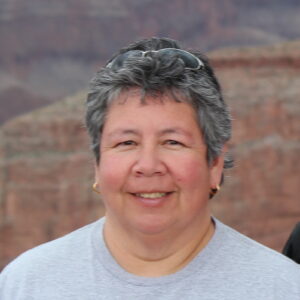
Dr. Wilma Trujillo & Dr. Guy Beresford
Research Group: Soil Water and Plant Testing Labratory
Research Overview: Advance sustainable agriculture through hydroponics, aquaculture, and innovation, addressing global food security challenges
More About Dr. Trujillo's Research
Dynamic Soil Properties – Measurement of soil health indicators such as soil respiration, soil carbon, particular organic matter, soil texture and aggregate stability.
What Projects Can Students Engage In?
Skills Students Will Learn
Students working on our soil lab will learn a variety of skills, including:
- Analytical Skills: The ability to analyze soil samples and interpret test results accurately.
- Attention to Detail: Precision is crucial in soil testing to ensure accurate results.
- Problem-Solving Skills: Students will develop the ability to troubleshoot and resolve issues that may arise during testing.
- Communication Skills: Effectively conveying results and findings to project director
- Teamwork: Collaborating with other team members to complete projects and share knowledge.
- These skills are essential for success in the field of soil testing and contribute to the overall effectiveness of soil management practices.
How Big is The Research Group, and Who Would Students Be Working With?
The lab includes a lab manager, two technicians, and four lab assistants

Dr. Jake Holley
Research Group: Metropolitan Agricultural Research Center (MARC)
Research Overview: Advance sustainable agriculture through hydroponics, aquaculture, and innovation, addressing global food security challenges
More About Dr. Holley's Research
The Metro Ag Research Center focuses on applied research in greenhouses, hydroponics, and vertical farming. Our research aims to test and validate new technologies, microbial inoculants, and fertilizer management strategies in Controlled Environment Agriculture.
What Projects Can Students Engage In?
Students may work on applied research projects in controlled environment agriculture, including greenhouse and hydroponic crop trials focused on growth, yield, and nutrient management. Activities include experimental setup, routine crop monitoring, data collection (plant growth and environmental variables), and assisting with data organization and analysis.
Skills Students Will Learn
Students will develop hands-on skills in greenhouse and hydroponic production, experimental design, and quantitative data collection. They will also gain experience in data management, basic statistical analysis, and communicating research results in written and verbal formats.
How Big is The Research Group, and Who Would Students Be Working With?
2 to 3 full time research associates, in addition to 2 co-managers. Undergrads will be primarily working with research associates
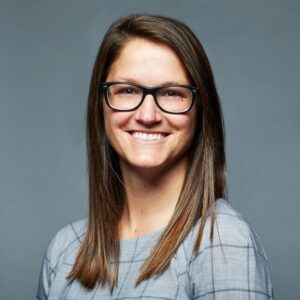
Dr. Katie Weimer
Research Group: GenesisTissue Inc.
Research Overview: GenesisTissue uses proprietary 3D bioprinting to create personalized, living regenerative tissue implants restoring human form and function
More About Dr. Weimer's Research
Their mission is to create a degradable, bioprinted breast tissue scaffold personalized for patients, with the ability to become 100% native tissue in the breast.
What Projects Can Students Engage In?
mechanical testing, microscope imaging, basic cell culture / pipetting, 3D printing, post processing of 3D printed parts, biomaterial testing
Skills Students Will Learn
protocol development, protocol execution, data collection and analysis, exposure and still improvement in the afore mentioned areas (mechanical testing, microscope imaging, basic cell culture / pipetting, 3D printing, post processing of 3D printed parts, biomaterial testing, etc)
How Big is The Research Group, and Who Would Students Be Working With?
4 Full time employees at GenesisTissue. Which employee is student would work with depends on student skills and best project to pair him/her with.

Ariana Villarreal
Research Group: Denver Water
Research Overview: Denver Water proudly serves high-quality water and promotes its efficient use to 1.5 million people in the city of Denver and many surrounding suburbs
More About Villarreal's Research
The Laboratory group operates a state-certified laboratory, processing over 50,000 samples annually, and manages Denver Water’s drinking water compliance program. Lab team members provide analytical expertise in organic, inorganic, microbiological, and field analysis, supporting a wide range of regulatory, watershed, treatment, and capital project monitoring efforts. Our top priority is to provide high-quality, reliable data throughout all of our core programs.
What Projects Can Students Engage In?
Analytical tasks pertaining to compliance analyses that relate to Colorado primary drinking water regulation. Potential analysis of source water for initial testing of algal toxins, this would include joining the sample collection team on reservoir collections.
Skills Students Will Learn
Laboratory analytical skills, best lab practices, laboratory safety, field safety, sample collection processes, calibration and use of field instrumentation,
How Big is The Research Group, and Who Would Students Be Working With?
Team of 22 separated into two groups: Lab with 12 members and Monitoring with 10 members. Student would be working with a team Lead
Giving Opportunities
With your help, more students can participate in life-changing experiences
Your generosity opens doors for more students to participate in the OURA Lab at CSU Spur. Your donations help provide hands-on experiences, mentorship, and resources that empower students to grow their skills, pursue their passions, and create lasting change in their communities.
Under “Designations“, select “All Other Areas Funds” and scroll to find “TILT Undergraduate Research and Artistry” to support undergraduate research and artistry at CSU

A special thank you for the financial support support from Chevron Corporation!
Questions?
Submit your questions or comments below and a member of our team will get back to you as soon as possible!