
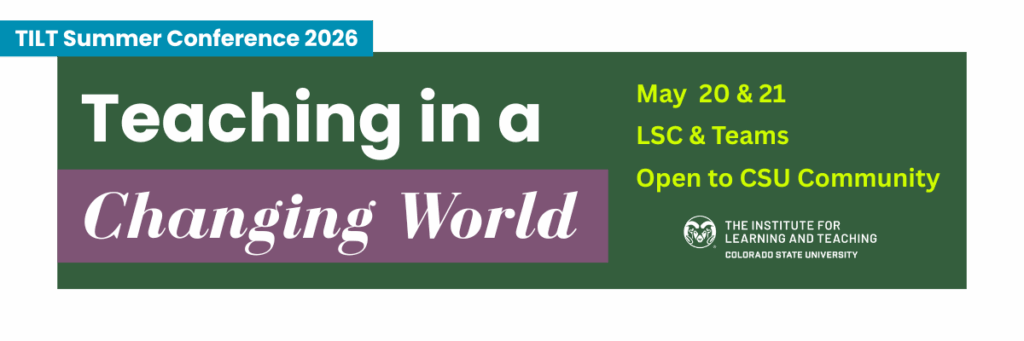
Summer Conference 2026 Call For Proposals
We invite faculty, staff, and graduate teaching assistants to submit session proposals for the 2026 Summer Conference.
Presenters may choose to share their work either in person or in an online format.
During the submission process, you’ll be asked to select one session type from six available options and indicate one or more focus areas that best align with your session’s theme.
Important Dates
Proposal Submission Deadline: Wednesday, February 4
Notification of Acceptance: End of March, 2026
Conference Dates: May 20-21, 2026
Conference Focus Areas
Teaching with AI
Exploring how artificial intelligence is reshaping teaching, learning, assessment, and what it means to be a college student and think critically in the 21st century. How do we integrate AI thoughtfully while preserving – and enhancing – authentic learning, human connection, and intellectual development?
Meeting Students Where They Are, Preparing Them for What's Next
Understanding the actual humans we teach – first-generation students, Gen Z learners, post-pandemic students, student-parents, student veterans, adult learners, and transfer students – their lives, needs, strengths, and the assumptions we need to unlearn. Drawing on frameworks like Universal Design for Learning (UDL) and the notion of servingness, how do we create truly inclusive and responsive learning environments? How do we prepare students with skills that transfer, adaptability for careers that don’t yet exist, and the capacity to build meaningful connections? Exploring career-readiness, essential skills, authentic assessment, High-Impact Practices (HIPs), and developing students’ humanity – their ability to know and be known by others—as resistance to dehumanization.
Radical Hope: Teaching When Everything Feels Hard
Sustaining purpose, joy, and possibility in uncertain times – for ourselves and our students. How do we create classrooms that are spaces of care, resilience, and hope even when the world feels overwhelming and challenging?
Slow Pedagogy in a Speed-Obsessed World
Creating space for deep learning, teaching nuance and complexity, and contemplative practices when everything screams “faster” and “simpler.” How do we resist the pressure to constantly accelerate and instead cultivate depth, reflection, and meaningful engagement with complex ideas?
Change Agents: Teaching and Leading During Institutional Transformation
Faculty and student leadership, advocacy, and driving institutional change in higher education. How do we navigate and shape institutional transformation – including the integration of new technologies like AI – while staying grounded in what matters most: student learning and success? How do we leverage High-Impact Practices (HIPs) and lead change that enhances learning and creates more equitable, responsive institutions?
Session Types
Please note: Engagement Stations and Poster Sessions will run concurrently during the conference. Please submit a proposal for only one of these formats, not both.
Interactive Workshop
60 minutes | Standalone session
These interactive sessions combine research-informed content with engaging, hands-on activities designed to deepen learning. Proposals should focus on broad relevance and active participation rather than a lecture-style approach.
Research Presentation
20 minutes | Grouped in 60-minute sessions with two other presentations
Present your completed or in-progress SoTL or DBER work within scholarly frameworks and relevant literature. Each one-hour session will feature three 20-minute presentations and grouped with two other presentation. Submitters sign up to present a single talk.
Lightning Talk
7 minutes | Multiple talks per 60-minute session
Deliver a 7-minute presentation on an innovative teaching practice, tool, or idea that align with the Teaching Effectiveness Framework and provide actionable takeaways. Each session will feature multiple thematically grouped talks; presenters sign up to deliver one
Engagement Station
3-5 minute demonstrations | 45-minute session with circulating attendees
Attendees rotate through mini-stations for 45 minutes, engaging in multiple presentations of teaching strategies, tools, or techniques. Presenters facilitate these interactive experiences and highlight adaptable practices others can apply in their own contexts.
Poster Session
5 minute discussions | 45-minute session with circulating attendees
Display research, programs, or initiatives at any stage of development. Presenters engage attendees in informal discussions for 45 minutes, making posters ideal for early-stage research, program evaluations, classroom inquiry, or innovative projects ready for sharing.
Roundtable Discussion
60 minutes | Standalone session
Facilitate structured, open dialogue on timely topics, encouraging diverse perspectives and collaborative problem-solving over 60 minutes. Proposals should outline discussion topics and key focus points rather than a single project or experiment.
Contact Information

Anastasia Williams
Director of Teaching Excellence
Instructional Innovation and Engagement
Contact
Email: [email protected]