
Components of the Teaching Effectiveness Framework
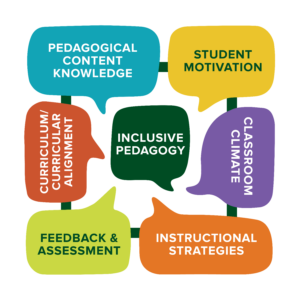 Effective teaching is a complex challenge that requires a clear, evidence-based approach to ensure quality and consistency across disciplines. This complexity can make evaluating teaching and guiding professional development daunting.
The Teaching Effectiveness Framework simplifies this process by organizing teaching into seven interrelated domains with Inclusive Pedagogy at its core. Each domain plays an integral role in supporting student learning and success. TILT recommends faculty focus on one domain at a time to approach professional growth in a manageable, meaningful way.
The seven domains of the Teaching Effectiveness Framework (TEF) align with the definition of effective teaching in the CSU Faculty Manual:

