
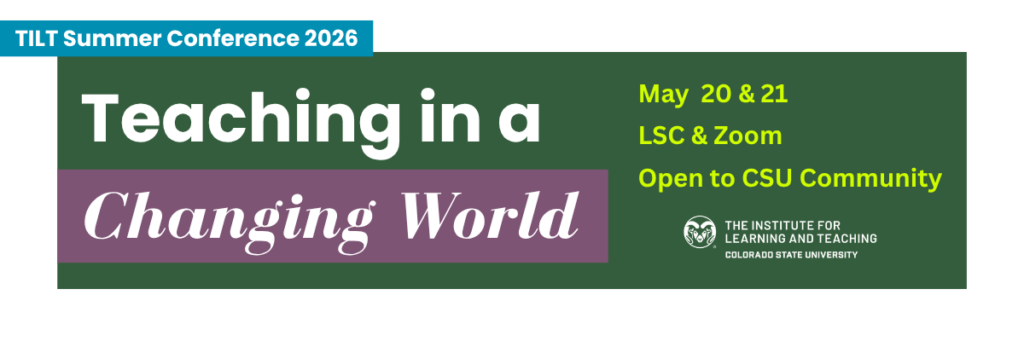
We’re grateful to everyone who participated in and supported this year’s Summer Conference! The conversations, ideas, and collaboration shared throughout the event helped make it a meaningful experience for our teaching and learning community.
We’d also like to extend a very special thanks to our sponsors, the Office of Inclusive Excellence (OIE) and The Association for Undergraduate Education at Research Universities (UERU), for their generous support in helping make this year’s conference possible.
Can’t wait to see you all at Summer Conference 2027!
Summer Conference 2026: Teaching in a Changing World
Education is evolving—shaped by new technologies, diverse learners, and shifting expectations. As educators, we have the opportunity to reimagine what teaching and learning can be in this moment of change. This year’s TILT Summer Teaching Conference invites you to embrace radical hope: the belief that our work as educators matters, that human connection and curiosity can counter isolation, and that our classrooms can be spaces of dignity, belonging, and joy. Join colleagues from across campus as we explore fresh perspectives, share ideas, and renew our sense of purpose in teaching and learning.
Summer Conference 2026 offers a rich, primarily in-person experience.
To support wider participation, both the keynote and the second-day keynote workshop will be available in a hybrid format.
All other sessions will be offered either in person or as online-only sessions.
Keynote Address: Staying Human(e) in a Changing World
It’s no secret that teaching in higher education feels more fraught than ever. The current social and political moment, along with the lingering aftershocks of Covid-19 and “pandemic pedagogy,” makes our work difficult indeed. From disengaged students to expanding workloads to a precarious climate for higher ed in general, things are increasingly atomized; the work we’re doing feels transactional, as opposed to transformational. How do we (re)discover the humanity, the humane-ness, that makes teaching and learning truly meaningful—even transformative—for all of us? This talk will suggest a conceptual framework and specific strategies to do that rediscovering, and offer some ways to advocate for ourselves and our students while doing so.
Keynote Speaker: Kevin Gannon
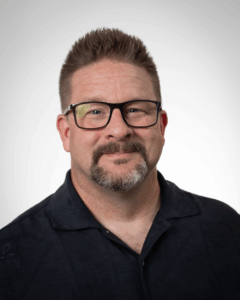
Kevin Gannon is Director of the Center for the Advancement of Faculty Excellence (CAFÉ) and Professor of History at Queens University of Charlotte in North Carolina. He spent nearly 25 years as a faculty member, serving as a program coordinator and department chair along the way, until moving full-time into faculty development. He is the author of Radical Hope: A Teaching Manifesto (West Virginia University Press, 2020), and the co-editor of The Campus Crisis Toolkit: Strategies and Solidarity for the Rest of Us (forthcoming from SUNY Press). His writing has appeared in outlets such as Vox, CNN, and The Washington Post, and he is a regular contributor to The Chronicle of Higher Education. Even in an administrative role, Kevin continues to work with first-year students (a particular passion of his) by teaching sections of Queens’ new student seminar course, the Queens Roadmap, every fall semester.

Keynote Address
Staying Human(e) in a Changing World
Wednesday, May 20 | 9-10:30am | LSC Theater
Keynote Workshop
Humans Teaching Humans: Practical Strategies for Humane Teaching in Changing Times
Thursday, May 21 | 9-10am | LSC Theater
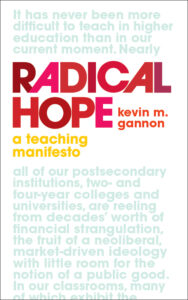
TILT Reads: Free Copies of Radical Hope for CSU Instructors
Join us for TILT Reads, a new program that unites the CSU community through a shared book and author experience. This year’s featured book is Radical Hope by Kevin Gannon, a powerful call to action for educators that explores the transformative potential of education. Gannon will also be the keynote speaker at TILT’s Summer Conference in May.
All CSU faculty, staff and students are invited to participate! Pick up a free copy of the book—100 copies are available at the TILT main office (room 231) Monday–Friday, 8 a.m.–5 p.m., while supplies last.
Let’s read, reflect, and engage as a community. See you at Summer Conference 2026!
Conference Schedule & Registration
This year’s summer conference is offered in a two-track format, giving CSU instructors the flexibility to attend sessions in person or online. To help you plan your schedule at a glance, sessions with a grey background are available online only, while all other sessions will be held in person. Please note that the Keynote Address and Keynote Workshop are the only hybrid sessions — meaning they are the only events available to both in-person and online attendees simultaneously. All other sessions are exclusively one format or the other, so be sure to check each session before registering, as online and in-person seats are managed separately.
Wednesday, May 20
Breakfast Day 1
8:00 – 8:30 am | LSC Theater
If you plan to attend breakfast, please be sure to register for this session.
Welcome
8:30 – 8:45 am | LSC Theater & Zoom
Join us for a conference introduction, welcome and opening remarks.
Register on Bridge for in-person attendance
Keynote Address: Staying Human(e) in a Changing World
9:00 – 10:30 am | LSC Theater and Zoom
Presenter: Dr. Kevin Gannon, Director of the Center for the Advancement of Faculty Excellence (CAFÉ) and Professor of History, Queens University of Charlotte, North Carolina
- It’s no secret that teaching in higher education feels more fraught than ever. The current social and political moment, along with the lingering aftershocks of Covid-19 and “pandemic pedagogy,” makes our work difficult indeed. From disengaged students to expanding workloads to a precarious climate for higher ed in general, things are increasingly atomized; the work we’re doing feels transactional, as opposed to transformational. How do we (re)discover the humanity, the humane-ness, that makes teaching and learning truly meaningful—even transformative—for all of us? This talk will suggest a conceptual framework and specific strategies to do that rediscovering, and offer some ways to advocate for ourselves and our students while doing so.
Teaching Effectiveness Framework Alignment: Inclusive Pedagogy
Crowded Rooms, Active Minds: Motivating Students in Large Classes
10:45 – 11:45 am | LSC 372-374
Morning Session A
Presenter: Dr. Kimberly Jeckel, Biomedical Sciences
- This interactive workshop will utilize core concepts and methods identified by the Teaching Effectiveness Framework (TEF) overview by focusing on the practical design and implementation of active learning and interactive classroom strategies in large-enrollment courses that do not have Graduate Teaching Assistants (GTAs) or Learning Assistants (LAs). The session is designed specifically for faculty who teach large classes independently and are seeking realistic, sustainable approaches to improve student engagement, enhance learning, and support student success without additional instructional personnel. The workshop will emphasize low-prep, high-impact strategies that can be implemented immediately, including in-class activities, structured discussion techniques, retrieval practice, formative assessments, and inclusive participation methods. Faculty will examine examples drawn from large-enrollment biology and biomedical science courses and will be guided through adapting these strategies to their own disciplinary contexts.
Teaching Effectiveness Framework Alignment: Instructional Strategies
Information Literacy and Student Success in the AI Era
10:45 – 11:45 am | LSC 376-378
Morning Session B
Presenters: Kristy Nowak, Kendra Macomber & Monica Latham, CSU Libraries
-
AI is an ever-increasing part of the information landscape, and students need a new set of skills to navigate information. In this session, we will discuss the importance of information literacy, including after the advent of AI. We will also discuss approaches for integrating information literacy skills/support into your courses, including: library instruction, course-integrated online tutorials, and resources including our peer-mentors. This session will include activities and discussion to create a plan to integrate information literacy skills into your courses.
Teaching Effectiveness Framework Alignment: Instructional Strategies
Preparing Learners for the Real World: Facilitating Team-Based Learning Sessions
10:45 – 11:45 am | LSC 386
Morning Session C
Presenter: Dr. Ellen Aster, Veterinary Medicine and Biomedical Sciences and Dr. Vishnu Kulasekaran, CU-Anschutz School of Medicine
-
This interactive workshop will introduce educators to Team-Based Learning (TBL), a powerful active-learning approach that can spark rich discussion, strengthen communication, and build teamwork through real-world problem solving. Drawing on four years of expertise teaching and supporting TBL at CU-Anschutz School of Medicine, session leaders will share practical insights for facilitating these sessions. Participants won’t just learn about TBL; they’ll experience it firsthand through this engaging, hands-on workshop that models TBL teaching strategies and invites collaboration, reflection, and shared expertise.
Teaching Effectiveness Framework Alignment: Instructional Strategies
Using Applied and Authentic Assessments for Student Career Readiness
(Online Only Session)
10:45 – 11:45 am | Zoom
Morning Session D
Presenters: Danielle Patterson & Margaret Weisenbach, CSU Online
-
Applied and authentic assessments add meaning, purpose, and direction to the assessments and work in your course. They enhance motivation. They provide resume and portfolio building opportunities for all students. These assessments make your course stand out as one that prepares students for real work in their field and one that purposely integrates AI use and literacy. We’ll explore the benefits of employing applied and authentic assessments and methods of incorporating them into your course before turning our attention to crafting your own authentic assessment. During this session, we’ll workshop your assessment idea(s), allowing you to walk away with your initial plan and objectives, and walk through actionable next steps to bring the assessment to life.
Teaching Effectiveness Framework Alignment: Feedback and Assessment
Lunch Day 1
11:55 am – 12:30 pm | LSC Theater
If you plan to attend lunch, please be sure to register for this session.
Playful Pedagogy
12:35 – 12:55 pm | LSC Theater
Studies have found that play and playfulness increase student motivation and engagement (Forbes, 2021). Join TILT for a fun activity and learn a little bit about playful pedagogy.
Engagement Stations & Research Poster Sessions
What is are Engagement Stations and Research Poster Sessions? Click Here
1:00 – 2:00 pm | LSC Theater
Engagement Stations
- Exam Retakes in a Large Enrollment Chemistry Class | Harmony Tucker
- Course Reserves: Making Teaching Materials Accessible to Students | Theresa Spangler & Matthew Diven
- Using Gradescope Rubrics to Encourage Self-Reflection | Melissa Denler
- Music Monday, Idiom Wednesday & Flula Friday: Thematic Topics that Integrate Culture and Remove Barriers to Student Learning | Frankie Wilcox
- Using AI to Enhance Student Learning While Reducing Instructor Workload | Rick Perry
- Undergraduate Research | Louise Allen & Ronnie Banerjee
- AI: Research or Tool? | Daniel Stein
- Authentic, Collaborative Assessment: Integrating Research Literature into Analytical Chemistry Exams | Jill Robinson
- Cards to Collaboration: Building High-Impact Cooperative Learning Communities | Katie Gerst
- Survey Says! Faculty Perspectives on TILT’s Needs Assessment Data | Bekah LeMahieu
- Video Tours as Experiential, Story-Driven Learning | Rodolfo Valdes-Vasquez & Svetlana Olbina
- Technical Briefs – Teaching Students to Communicate Green Practices | Svetlana Olbina and Rodolfo Valdes-Vasquez
- Sparking Learning through Image & Words: Creative Techniques for Student Engagement| Tobi Jacobi
- Ask Us About Alternative Grading | TILT’s Alt Grading Community of Practice (COP)
- Teaching in the Age of Answers: Designing for Thoughtfulness, Integrity, and Feedback | James Peth
Research Posters
- CSU Summer Enrichment Map: Enhancing Student Success Via Summer Session | Ann Van Ardsall
- Preparing Students for Workforce Opportunities in Agriculture: Micro-credentialing and Experiential Learning in a Changing World | Susan Melzer, Ellie Elllis & Deanna Narmuth-Covert
- Effective Recitation Structures in General Chemistry | Emma Rettner
- Enhancing Student Engagement and Professional Development through Podcasting | Lauren Chenarides, Aryn Baxter & Jenny Bennett
- Keep RoLLing! Enhancing Metacognition through Paired, Student-generated Study Aids | Michael Shavlik & Jennifer Neuwald
- Teaching accurate biological variation and complexity using cognitive bridging in an introductory biology course | Aramati Casper
Radical Listening: Strengthening Community Through Intentional Listening
2:15 – 3:15 pm | LSC 372-374
Afternoon Session A
Presenter: Dr. Leah Holz, Honors Program
- In this day and age our attention is a commodity and we all (students and teachers) can practice more mindful communication. In this interactive workshop, we will engage with radical and generous listening practices; we will reflect on our own experiences in the classroom, identify radical listening strategies that we are already doing, brainstorm and share new ideas, and explore ways to refresh our classes with meaning and connection. Participants will identify strategies to promote radical listening in the classroom and will leave with a developed class activity or project that uses radical listening skills.
Teaching Effectiveness Framework Alignment: Instructional Strategies
Now Entering the Slow Zone
2:15 – 3:15 pm | LSC 376-378
Afternoon Session B
Presenter: Alyson Huff, Philosophy
-
Students’ lives get hectic and busy (i.e., midterms, work schedules, childcare, politics, global concerns). They may show up in the classroom distracted and anxious. This session shares three ‘slow zone’ practices applicable in any course (private free-writing, verbatim reading with active listening, end of semester mapping reflection) which ‘force’ class to slow down, spend time digging in, and genuinely hear one another, without sacrificing learning.
Teaching Effectiveness Framework Alignment: Instructional Strategies
From Learners to Leaders: Undergraduate Learning Assistants in the Classroom
2:15 – 3:15 pm | LSC 386
Afternoon Session C
Presenter: Dr. Katriana Popichak, Microbiology, Immunology, and Pathology
-
This interactive workshop examines how Undergraduate Learning Assistants (ULAs) can be intentionally developed as learning leaders who support active, inclusive classroom environments. Using a structured ULA program embedded within large, upper-division STEM courses as a case study, the session highlights how peer educators are recruited, trained, and mentored to facilitate learning both in and beyond the classroom. Participants will be introduced to practical strategies for integrating ULAs into high-enrollment courses, including defined roles and expectations, pedagogical training, and mechanisms for fostering community and student engagement. Concrete classroom examples illustrate how ULAs support active learning through formative assessments, group work, hands-on activities, and peer-facilitated learning sessions.
Teaching Effectiveness Framework Alignment: Instructional Strategies
Beyond the Prompt, Part II: Designing with AI for Teaching and Learning
(Online Only Session)
2:15 – 3:15 pm | Zoom
Afternoon Session D
Presenter: Chris Geanious, TILT
-
Generative AI tools like Microsoft Copilot and CSU GPT are rapidly becoming part of many instructors’ workflows—but meaningful impact comes from how we design with them, not just how we prompt them. This interactive Zoom workshop is designed for entry- and mid-level AI users who are ready to move beyond experimentation toward intentional, pedagogically grounded use. Participants will work hands-on with Copilot prompts and CSU GPT agents to explore high-impact tools and strategies that support learning without outsourcing instructor judgment. Faculty will leave with actionable prompts, adaptable agent templates, and design principles they can immediately apply in their own courses.
Teaching Effectiveness Framework Alignment: Instructional Strategies
Ramskeller Networking
3:30 – 4:30 pm | LSC Ramskeller
- Join us for a drink and some food at our networking event at the Ramskeller in the Lory Student Center to end our great first day of Summer Conference! Unwind by connecting with friends and meeting new colleagues from across campus. Open to all conference attendees. TILT will provide refreshments and non-alcoholic beverages. The full beer menu and cash bar will be available. If you plan to attend, please register for this session.
Thursday, May 21
Breakfast Day 2
8:00 – 8:45 am | LSC Theater
If you plan to attend breakfast, please be sure to register for this session.
Keynote Workshop: Humans Teaching Humans: Practical Strategies for Humane Teaching in Changing Times
9:00 – 10 am | LSC Theater and Zoom
Presenter: Dr. Kevin Gannon, Director of the Center for the Advancement of Faculty Excellence (CAFÉ) and Professor of History, Queens University of Charlotte, North Carolina
-
It’s one thing to talk about human-centered teaching and learning in theory, but what does it look like our in actual practice? This interactive session will explore concrete and evidence-based strategies to do exactly that. Paying close attention to our particular course and student contexts, we’ll brainstorm ways to put our principles into action and create spaces that foster engagement, motivation, and curiosity for students. You’ll leave with some specific ideas you can integrate into your teaching practices right away (if you wish), and the first steps of a plan to do so.
Teaching Effectiveness Framework Alignment: Inclusive Pedagogy
Register on Bridge for in-person attendance
Roundtable Discussions
What is a Roundtable Discussion? Click Here
10:15 – 10:45 am
Morning Session A
Roundtable 1: Effectiveness of Three Options for Summative Writing Assignments
LSC Theater
- Presenter: Andrea Purdy
- Teaching Effectiveness Framework Alignment: Student Motivation
- Register on Bridge for in-person attendance
Roundtable 2: Why Writing Matters: What We Learned as Writing-Enriched Curriculum (WEC) Fellows
LSC 376-378
- Presenters: Jake Sherlock, Annie Krieg, Tian Guo & Craig Partridge
- Teaching Effectiveness Framework Alignment: Student Motivation
- Register on Bridge for in-person attendance
Roundtable 3: Reported AI Use Among Online vs. Face-to-Face Students
LSC Theater
- Presenters: Katie Gerst & Lilyana Ortega
- Teaching Effectiveness Framework Alignment: Student Motivation
- Register on Bridge for in-person attendance
Research Presentations
What is a Research Presentation? Click Here
10:15 – 10:45 am | LSC 372-374
Morning Session B
Research Presentation 1: Student Perspectives of Attendance in Undergraduate Courses
Presenters: Dr. Andrea Glaws & Juliana Searle, School of Education
-
This session describes the findings from a research study that sought to better understand what motivates college students to attend– and not attend– classes. The key findings will be described as well as what these themes illuminate about student attendance
Teaching Effectiveness Framework Alignment: Student Motivation
Research Presentation 2: Comparison of Asynchronous Online versus In-Person Education
Presenters: Dr. Greta LeDoyen & Dr. Jeanette M. Garcia, School of Sports Sciences, West Virginia University
-
Is there a difference in performance and perceived stressors between online and in class experiences? This question will be addressed based on the findings of a mixed methods study.
Implications for practice and future research will be discussed.
Teaching Effectiveness Framework Alignment: Student Motivation
Research Presentations
What is a Research Presentation? Click Here
10:15 – 10:45 am | LSC 386
Morning Session C
Research Presentation 1: “You Get to do Research! You Get to do Research! Everybody Gets to do Research!” – Three Vignettes of Equitable Course Undergraduate Research Experiences (CUREs)
Presenter: Dr. Ronnie Banerjee, Chemistry
-
In this talk, vignettes of three CURE-type projects designed, implemented and disseminated at our teaching laboratories will be presented – two suitable for a materials or nanochemistry teaching laboratory and the third focused on a classic coordination chemistry synthesis with application in bioinorganic chemistry. The nanochemistry experiments focus on the design, synthesis, as well as structural and functional characterization of transition metal oxides and ferrites, with potential applications in wastewater treatment, while the coordination chemistry CURE has the students synthesize a variety of Schiff base vanadyl complexes and test their inhibitory action on alkaline liver phosphatase, as a surrogate marker of their antidiabetic activity.
Teaching Effectiveness Framework Alignment: Instructional Strategies
Research Presentation 2: Keep RoLLing! Enhancing Metacognition through Paired, Student-generated Study Aids
Presenters: Dr. Michael Shavlik & Dr. Jennifer Neuwald, Biology
-
This talk presents the RoLL (“Reflect on Learning” Loop) model, a paired study/reflection strategy designed to strengthen student metacognition in large introductory STEM courses such as LIFE102 at CSU. By linking learning objectives, course content, student‑generated (and AI‑assisted) practice questions, and exam performance, the model encourages deeper connections and more intentional study habits. We share quantitative and qualitative findings on how this approach influences student performance, retention, and perceptions of their learning.
Teaching Effectiveness Framework Alignment: Instructional Strategies
Understanding Today’s College Students
(Online Only Session)
10:15 – 11:15 am | Zoom
Morning Session D
Presenter: Dr. Rye Vigil, OIE
-
Who are college-going students today, and what helps them persist and succeed? In this interactive, research-informed session, we will myth-bust common assumptions about “today’s students,” explore the real conditions shaping learning and resource navigation, and build a shared, practical definition of student success. Participants will leave with concrete, student-ready strategies to strengthen engagement and support more informed, effective interactions with students. This session is offered as part of the Grow Program for Student Success. All are welcome.
Teaching Effectiveness Framework Alignment: Classroom Climate
Preparing Students for Adaptive, Purposeful Futures Through Career Curricular Integration
11 am – 12 pm | LSC 372-374
Morning Session E
Presenters: Nickey Pietila & Chase Weldon, Career Center
-
Students increasingly expect their academic coursework to connect clearly to their future careers, yet those connections are often implied rather than made explicit. Research and institutional data consistently show that when career education is intentionally integrated into the curriculum—early and often—students demonstrate stronger engagement, meaning-making, persistence, and confidence in their academic pathways. Faculty are uniquely positioned in this work: students consistently identify instructors as one of their most trusted sources of career guidance, even when faculty do not view themselves as “career experts.”
This interactive workshop introduces scalable, student-centered approaches to career education curricular integration grounded in the career ecosystem model. Drawing on cross-college partnership work between academic units and the career center, participants will explore practical strategies for embedding career connections into courses regardless of discipline, content area, or class composition. Examples will span seven academic colleges and include low-lift activities, assignments, reflective prompts, and AI-supported tools that complement existing learning outcomes rather than compete with them.
Teaching Effectiveness Framework Alignment: Instructional Strategies
AI-Assisted Rubrics for Equitable, Efficient Feedback
11:00 am – 12:00 pm | LSC 376-378
Morning Session F
Presenter: Dr. Pinar Omur-Ozbek, Civil and Environmental Engineering
-
This interactive workshop will guide participants through a human-in-the-loop process for creating and refining analytic rubrics with generative AI as a drafting assistant, while maintaining instructor judgment and alignment with learning outcomes. Participants will explore how to design clear, equitable rubric criteria, calibrate across multiple users, and develop practical strategies for using rubrics consistently in their own courses.
Teaching Effectiveness Framework Alignment: Feedback and Assessment
Common Data Types in Education Research
11:00 am – 12:00 pm | LSC 386
Morning Session G
Presenter: Dr. Eleanor Sayer; Co-director of the Professional Development for Emerging Researchers (PEER) Institute
-
New education researchers are often curious about how much data they need, or whether their small classes are big enough to collect enough data. This workshop outlines common data types and quantities in education research, and how to match your data types to your research questions. In advance of this workshop, you are invited (but not required!) to read “Data and Access“.
Online Conference Closing: Debrief & Wrap Up
11:30 am – 12 pm | Zoom
Morning Session H
(Online Only Session)
Presenter: Kristi Sommerville, TILT
-
Debrief and planning session for virtual attendees
Celebration of Teaching Lunch
12:10 pm – 1:35 pm | LSC Theater
Please join us in celebrating teaching at CSU! At this time we will honor the recipients of the N. Preston Davis, Community-engaged Learning, and Teaching Effectiveness Fellow Awards. If you plan to attend lunch, please be sure to register for this session.
Teaching Recognition in a Changing Academic Landscape: A Leadership Roundtable
What is a Roundtable Discussion? Click Here
1:45 – 2:35 pm | LSC Theater
Presenter Names and Title:
- Amy Parsons, CSU President
- Lise Youngblade, Provost and Executive Vice President
- Michael Galchinsky, Vice Provost and Dean for Undergraduate Affairs
- Mendy Smith, Vice Provost for Faculty Affairs
- Jen Aberle, Associate Dean for Undergraduate Affairs, College of Health and Human Sciences
- Ellie Light, Associate Dean for Undergraduate Affairs and Student Success, College of Liberal Arts
- Tod Clapp, Associate Dean for Academic and Student Affairs, Biomedical Sciences
- Moderator: Sue Doe, Executive Director of the Institute for Learning & Teaching
Building on themes raised by our keynote speaker, Dr. Kevin Gannon, we are envisioning a dialogue that explores how we demonstrate—structurally and culturally—that teaching matters at CSU. The conversation could touch on how institutional systems, policies, recognition structures, and narratives signal the value of teaching and the scholarship of teaching and learning. Our goal is to create space for thoughtful reflection and dialogue between faculty and leadership on these themes.
Leveraging AI to Bridge the Gap Between Theory and Reality
2:45 – 3:45 pm | LSC 372-374
Afternoon Session A
Presenter: Raul Galang, Marketing
- How can instructors leverage AI to design and deliver a high-impact practicum that mimics the speed of global industry? This session explores a “real-time” pedagogical experiment spanning two courses: a completed Product Design (MKT364) course and a current, AI-intensive International Marketing (MKT365) course. By sharing both “wins and losses,” this session provides a roadmap for faculty to embrace AI not just as a tool, but as a co-pilot for rapid course innovation and a catalyst for professional student judgment. Attendees will receive an infographic mapping the professor’s AI-enabled workflow evolution.
Teaching Effectiveness Framework Alignment: Pedagogical Content Knowledge
Lightning Talks
What is a Lightning Talk? Click Here
2:45 – 3:45 pm | LSC 386
Afternoon Session B
7-minute presentations
- The Research Discovery Series: Linking Graduate Research to Undergraduate Education | Sareen Fiaz
- Proactively Engaging Students Using Canvas Analytics| Brittney Morgan
- From Orientation to Belonging: A Scalable Model for Graduate Success | Sara Tompkins
- Specifications-Based Grading Modules to Increase Student Motivation | Cayla Bellamy
- Let’s Put “Fun” Back into Fundamentals: A Case for Memes | Niccole Nelson
- Strengthen Student Learning Skills: Metacognition in CHEM 111 | Kerry MacFarland
Conference Wrap up and Giveaway
3:55 – 4:30 pm | LSC Theater
Bring your notes, plans, ideas, and questions to the conference wrapper. We’ll spend time reflecting on the conference and connecting with colleagues. Don’t forget to bring your tickets!