
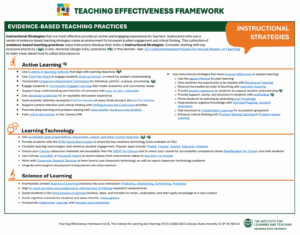
FIRST - FIND YOUR COMFORT ZONE
If active learning is new to you, START WITH ONE NEW TECHNIQUE at a time. The more you make active learning a part of your routine, the more confident you will be in incorporating new practices.
ACTIVE LEARNING TIPS:
- Vary activities to keep students alert
- Model how you want students to interact with each other
- Share the activity outcomes with students
- Debrief activities to review what students learned
TECHNOLOGY IN THE CLASSROOM
Consider how technology will serve to enhance your lessons and promote accessibility. Be prepared to test it out before trying something totally new and have a back-up plan if and when it doesn’t work as planned.
There is nothing wrong with low-tech/ no-tech approaches, just be sure you are choosing what will work best for you and your students.
FOR LARGE COURSES
- Make active learning part of the culture of your class by incorporating it early and often.
- Tell students why it’s important and be consistent with the routine that you put in place.
- Use an audible timer and attention getter to bring students back together.
- Consider assigning students to groups for the entire semester and spend the first few weeks working with students to get into groups quickly to avoid wasting class time.
ALIGN ACTIVITIES WITH THE SCIENCE OF LEARNING
You can support students by engaging them in activities that mimic how learning works.
Predicting: Activate and build on students’ prior knowledge with activities such as pre-tests, brain dumps, and think-pair-share about upcoming topics.
Connecting: Help students connect content to previous lessons, everyday experiences, future careers, and how students can use knowledge and skills to make the world a better place.
Interleaving: Have students engage with and connect often to previously learned material.
Practicing: During class, give students many opportunities to practice explaining concepts to each other, solve problems, and apply knowledge and skills to novel situations.
USE PRACTICES WITH A PROVEN EFFECT SIZE ON STUDENT LEARNING
John Hattie’s meta-analysis of over 1200 studies reveled the 252 influences and effect sizes on student learning, including a variety of instructional strategies. Some strategies that made it to the top 20 include:
- The Jigsaw Method where each student in a small group engages with a portion of content – a section of reading, a section of a video or podcast, one concept in a series – and teaches their portion to the rest of the group.
- Cognitive Task Analysis where students are asked to determine the level of cognition or critical thinking needed to complete a task. Align tasks with Bloom’s or Fink’s Taxonomy and ask students to determine the level of thinking needed to complete the task. Then have them complete the task.
- Concepts maps or other graphic organizers help students make sense of concepts. This can be a one-time assignment for a difficult concept or a long-term assignment that students add to as concepts build on each other.
- Short lectures, 10 minutes or less, followed by discussion and/or activity about the concept just covered.
ADDITIONAL CONSIDERATIONS FOR TEACHING ONLINE
A common fear is that the online classroom doesn’t lend itself to active learning in the same way that the RI classroom does. While it may look a little different or be asynchronous, you can use active learning in your online course just as you would in your face-to-face course – you just might have to make a few tweaks to get there! Learn more at Active Learning Strategies by Instructional Modality.
2) USE THE TEACHING EFFECTIVENESS FRAMEWORK TO DEVELOP YOUR TEACHING
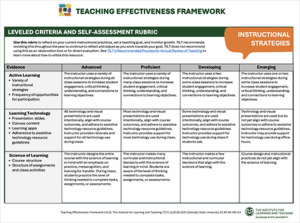
SELF-REFLECTION RUBRIC
Self-Reflection rubrics for you to use as you reflect on your teaching practice
FOR ANNUAL REVIEW OF TEACHING
1) Choose a Domain
2) Set One Goal
3) Learn and Practice
4) Reflect
Starting with one goal, the step-by-step guidance takes the guesswork out of the annual review process
TILT PROFESSIONAL DEVELOPMENT
Best Practices in Teaching (BPiT) courses that align with the Instructional Strategies Domain
- Active Learning
- Planning an Effective Class Session
- Accessible and Inclusive Electronic Content
Observe and be observed by colleagues in a non-evaluative, supportive, and growth-based way
Teaching Effectiveness Initiative Program
Earn an Instructional Strategies domain certificate
RECOMMENDED
READING


Selected chapters from these recommended books directly address instructional strategies.
Stop by TILT 231 to check out a copy or learn more about our Book Club Kits.
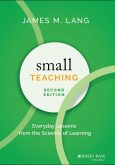
- Small Teaching (CH 1-3, 4-6)
- How Learning Works (CH 3, 5, 8)
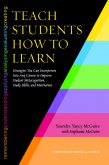
- Teach Students How To Learn (CH 3-5)
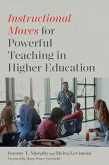
- Instructional Moves for Powerful Teaching in Higher Education (CH 2-6)
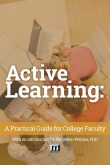
- Active Learning: A Practice Guide for College Faculty (Part 2-3)
- Distracted: Why Students Can’t Focus and What You Can Do About It (CH 5-7)
- Engaged Teaching: A Handbook for College Faculty (CH 6, 10-12)
- What the Best College Teachers Do (CH 2, 4-5)