


PEDAGOGICAL CONTENT KNOWLEDGE

When you know your students’ strengths, misconceptions, and how they learn best in your discipline, you can present content so that it is accessible, understandable, and engaging to all learners.

1) START WITH KEY PRACTICES

horsetooth blue icon of a lighbulb turning on

KNOW YOUR STUDENTS

Know what your students bring into the classroom. Assess their experience in your discipline, their prior knowledge and their misconceptions. Use this knowledge to plan lessons and activities.

horsetooth blue icon of hand picking between three icons and choosing the middle option with a checkmark

CHOOSE INSTRUCTIONAL STRATEGIES

Learn which teaching strategies work best for your students in your discipline. This might mean attending a discipline-specific teaching conference or trial and error in your classroom. Some strategies, like case studies, work well across disciplines; others, like problem-based learning is especially beneficial in STEM courses.   

Support students as they become critical thinkers in your field. Teach them to ask questions, draw conclusions, judge credibility, and assess quality, and give them many opportunities practice these skills. Teach students how to become consumers of knowledge in your field: how to read and research in your discipline. In other words, teach how to become an expert like you.

Horsetooth blue scaffolding icon

CONSIDER SEQUENCE AND SCAFFOLDING

Novice learners need to master lower order thinking skills and tasks before they can tackle higher order thinking such as analysis and evaluation. Support students by scaffolding concepts in an order that makes sense to them. Give students many opportunities to practice skills before moving on to new concepts.  Be sure to step back often to share how concepts fit into the larger picture. Better yet, ask students to do this.

Horsetooth Blue Laptop Icon

ADDITIONAL CONSIDERATIONS FOR TEACHING ONLINE

Synchronous tools such as chats or web conferences can be beneficial to creating community and common experiences but challenging to manage. This isn’t to say you should never incorporate synchronous learning but be mindful of the reasons that students take courses online. Many students take online classes because they have full-time jobs, military, or family obligations that limit their availability. Use synchronous learning sparingly, communicate any requirements well in advance, and be prepared to offer alternatives to students who do not have flexible schedules.

2) USE THE TEACHING EFFECTIVENESS FRAMEWORK TO DEVELOP YOUR TEACHING

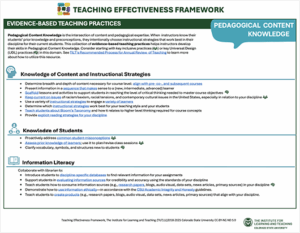
EVIDENCE-BASED PRACTICES

Try some of these evidence-based teaching practices in your course

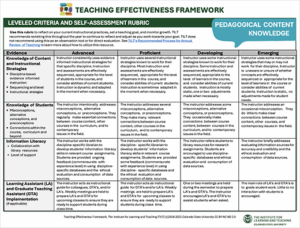
SELF-REFLECTION RUBRIC

Self-Reflection rubrics for you to use as you reflect on your teaching practice

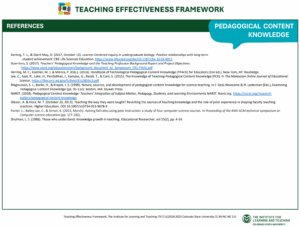
REFERENCES & RESOURCES

Take a deep dive into Pedagogical Content Knowledge

FOR ANNUAL REVIEW OF TEACHING

1) Choose a Domain

2) Set One Goal

3) Learn and Practice

4) Reflect

Starting with one goal, the step-by-step guidance takes the guesswork out of the annual review process

TILT PROFESSIONAL DEVELOPMENT

Teaching Effectiveness domains bubbles

Teaching Squares Program

Observe and be observed by colleagues in a non-evaluative, supportive, and growth-based way

Teaching Effectiveness Initiative Program

Earn a Pedagogical Content Knowledge domain certificate

RECOMMENDED

READING

Selected chapters from these recommended books directly address pedagogical content knowledge.

Stop by TILT 231 to check out a copy or learn more about our Book Club Kits.  

  • Engaged Teaching: A Handbook for College Faculty (CH 2)
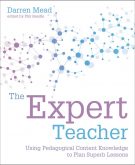
  • The Expert Teacher: Using Pedagogical Content Knowledge to Plan Superb Lessons 
  • How Learning Works (CH 2-4)
  • What the Best College Teachers Do (CH 2-4)