Set One Goal In One Domain

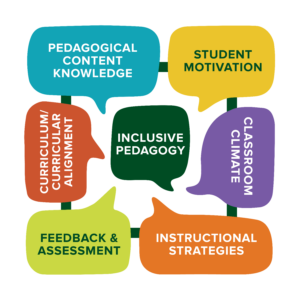
teaching effectiveness framework diagramTo support the development and evaluation of teaching, TILT recommends faculty use the TEF to set a teaching goal for annual review of teaching and offers this Departmental Process for Developing and Evaluating Teaching Effectiveness to department chairs/heads and tenure and promotion committees. Faculty can use this Goal Setting Form and examples of teaching goals that align with the TEF to set a teaching goal for annual review of teaching. 

By using the TEF, departmental leaders can guide faculty development with clarity and consistency.  All professional development at TILT aligns with domains from the TEF so that faculty can easily access programs, workshops, and materials that support their teaching goal in a chosen domain. Professional development culminates in the optional Teaching Effectiveness Initiative (TEI) program that provides a space for faculty to reflect on implementation of evidence-based practices and earn certificates of achievement and recognition for their teaching efforts. 

Faculty and department chairs, heads, and P&T committees can follow these four steps to succeed in the annual review process: 

Step 1

Choose a Domain

Step 2

Set One Goal

Step 3

Learn and Practice

Step 4

Reflect

Step Faculty Department Chair/Head/P&T Committee
1 Choose a Domain
  • Begin the goal setting process by choosing one of the seven domains of the TEF at a glance.
  • Choose a focus area within one of the TEF domains.
Review the Recommended Goal Setting Process
2 Set One Goal
Support Faculty Goal Setting
3 Learn and Practice
  • Attend professional development (PD) that aligns with your goal – all TILT PD aligns with domains of the TEF.
  • Incorporate new or refine existing teaching practices.
  • Engage in peer observation with colleagues. Use an observation form from the Teaching Squares program that aligns with your goal domain.
Support Faculty Professional Development Efforts
  • Partner with college TEN (Teaching Effectiveness Network) Coordinator, departmental teaching committee, or TILT to promote professional development opportunities.
  • Provide opportunities for faculty to share teaching ideas in small groups or at department meetings.
  • Organize a peer observation process for faculty to learn from and support each other.
  • Check-in with individual faculty seeking or needing support on a teaching goal.
4 Reflect on Teaching and Goal Attainment
  • Reflect on goal attainment based on self-reflection, student feedback, and other sources of evidence.
  • Assemble data points or evidence related to the goal.
  • The Teaching Effectiveness Initiative (TEI) provides an in-depth reflection form that can be used to earn certificates of achievement in each TEF domain; you can also use the documentation from the TEI as evidence for annual review and/or Promotion and Tenure.
Evaluate Teaching
  • Set up a rotation to observe faculty every two to three years.
  • Meet with individual faculty for annual review.
  • Know that evidence of teaching effectiveness has Strengths and Limitations but that three forms of evidence should create a complete picture of the quality of teaching occurring.
  • Identify individual and department teaching strengths and teaching needs.
  • Reflect on progress towards the long-term departmental teaching effectiveness goal.
"TEF is highly recommended by me and the T&P committee. Annual evaluations and the promotion process tend to go smoothly when faculty use the TEF to structure and describe how they teach, what issues they are currently working on, and how their teaching has evolved over time.” 
Julie Baumgart-Reiker
Department Head and Professor, HDFS

More on the Teaching Effectiveness Framework