
The Teaching Effectiveness Framework to Develop and Evaluate Teaching
The Teaching Effectiveness Framework (TEF) is comprised of seven essential, interrelated domains of evidence-based teaching practices—for face-to-face and online instruction. Each domain includes a collection of teaching practices to improve student learning, a rubric for self-assessment, and a resources page.
Why use a teaching framework?
Teaching frameworks provide a structured, standardized, and comprehensive approach to developing and evaluating teaching. A framework provides a shared understanding of evidence-based practices that support student learning and a common language for discussing and giving feedback on teaching. Using a framework to develop and evaluate teaching assures that feedback and evaluation of teaching are transparent, consistent, and equitable.
TILT’s Teaching Effectiveness Framework and recommended process for annual review of teaching guides instructors to set and achieve meaningful goals, simplifies the work of department leadership, and aligns with the CSU Faculty Manual and Office of the Provost’s recommendations.
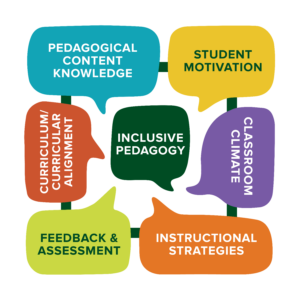
Teaching Effectiveness Domains
Instructional Professional Development Opportunities
Community of Practice: Alternative Grading Practices
Addressing Instructor and Student Burnout
Principles of the Teaching Effectiveness Framework
Grounded in the Scholarship of Teaching and Learning
- The TEF provides theory and evidence-based practices that support effective teaching, and thus, student It includes strategies relevant to face-to-face and online instruction.
- The TEF was developed over a 36-month period with input from numerous CSU stakeholders (VP of Diversity, Committee on Teaching and Learning, Committee on Non-Tenure Track Faculty, Provost for Faculty Affairs, Deans, Chairs, Faculty, TILT Equity Advisory Group) and an in-depth literature review of effective teaching. The TEF is a living document that will be updated periodically, as research on teaching and learning develops.
For more research and resources on each domain:
Inclusive Pedagogy | Curriculum/Curricular Alignment | Pedagogical Content Knowledge | Student Motivation | Instructional Strategy | Feedback & Assessment | Classroom Climate
Developmental and Self-Reflective
- The TEF is the foundational component of the comprehensive Developing and Evaluating Teaching Toolkit. The toolkit includes a recommended process for annual review, options for goal setting, and tools for measuring teaching effectiveness. The recommended process for developing and evaluating teaching incorporates the TEF as a starting point for annual goal setting.
- The TEF is designed to be developmental and self-reflective; it is not intended to be used as a stand-alone evaluative tool but rather as a resource for goal setting and reflection within an iterative process for annual review.
- Meaningful measures of teaching must separate the impact of the instructor from the many other factors that affect the attainment of educational outcomes. Teaching is a developmental process that takes time, experience, reflection, and support; the TEF is intended to be used as a supportive and self-reflective tool to improve teaching effectiveness and student success.
Asset-based
- The TEF acknowledges that just as students bring assets to their learning, instructors have a set of assets and strengths that they bring to their teaching.
- The TEF is designed to honor variety in effective teaching. Students benefit from the cultural wealth instructors bring to their teaching; the TEF encourages instructors to find their own path to teaching effectiveness, beginning with their strengths.
- The TEF is not intended to be used as an evaluative tool but as a starting point for self-reflection, setting goals and building on strengths.
Collaborative
- The TEF provides a common language and definition of teaching effectiveness that facilitates discussion of best practices in teaching among CSU faculty and between faculty and students.
- Effective teaching occurs when students attain course outcomes and goals that departments and/or instructors set. The TEF provides the components proven to consistently promote student success. The complexity of developing teaching effectiveness is reflected in the depth of the seven criteria in this framework. The TEF provides the foundation for faculty both within and across disciplines to collaborate with and support each other as they support students in their learning.
Grounded in Inclusive Pedagogy focused on Student Success
- The TEF threads student centered and inclusive pedagogy throughout each of the domains. While Inclusive Pedagogy is identified as its own domain, fundamental inclusive practices are identified in and woven throughout each of the other domains.
- The TEF honors the challenging and dynamic nature of teaching and elevates the role of teaching faculty at an R-1 institution.
- The TEF fosters an equitable approach to feedback on teaching and supports teaching success for all faculty demographics.
- The icon indicates inclusive teaching practices essential to being “Proficient” or “Advanced” in the other domains of the TEF.
Contact

Jennifer Todd
Senior Faculty Developer & Teaching Effectiveness Framework Program Manager